Learning Through Landscapes
From the macro lens of the biosphere to the micro lens of a distinctive locale, landscapes make our lives possible. This blog is dedicated to discovering the knowledge within our landscapes - the evolving scenery of our human backdrop, and the link between culture and nature.

Monday, June 9, 2014

Capturing the Landscape of the English Countryside, in France - Touring le Jardin du Plessis Sasnières

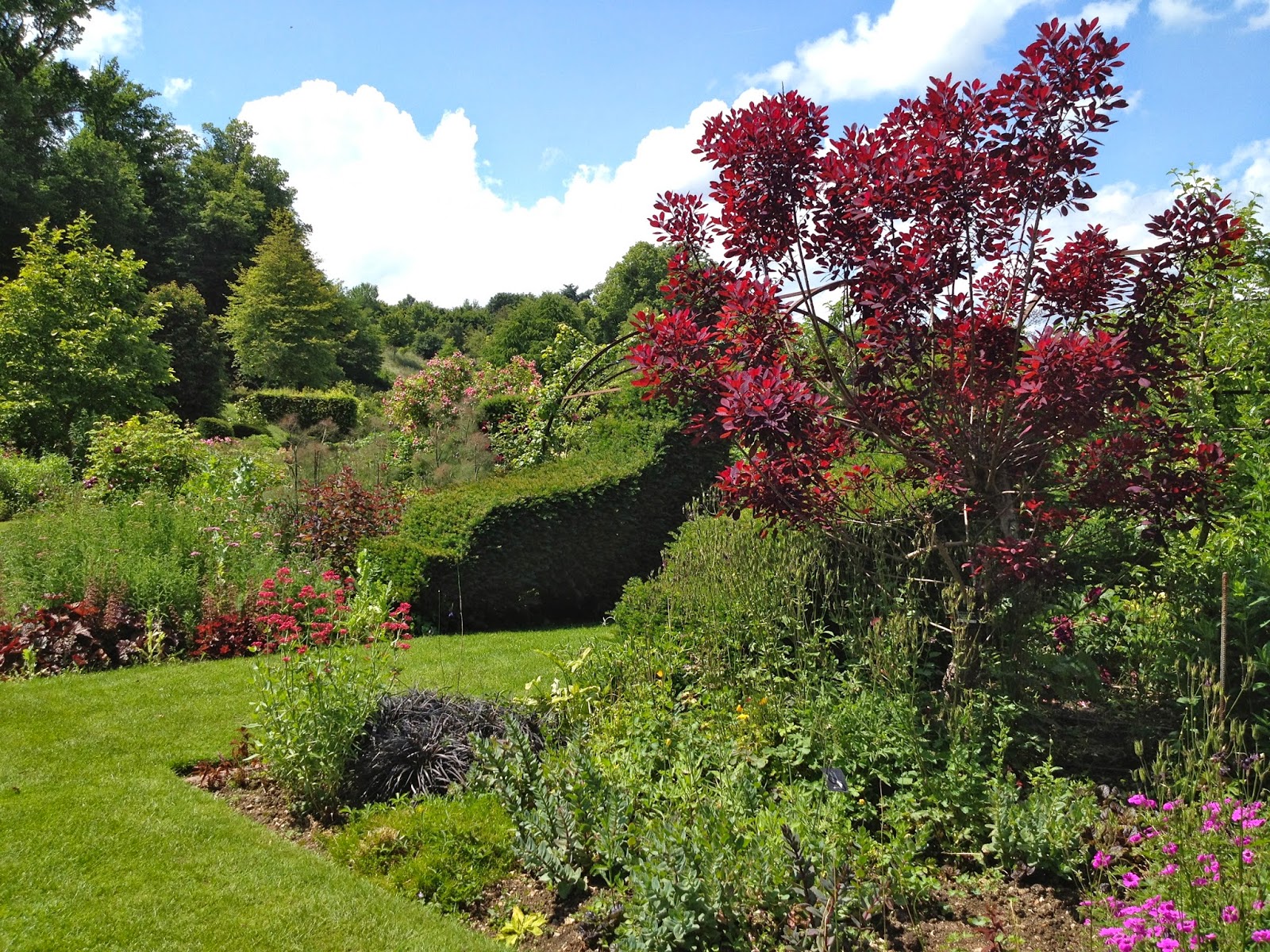
Initially inspired by the attempt to capture the beauty of the English countryside, The English style landscape garden takes into account the lay of the land. It represents an idealized style of nature, offering a balance between immaculately kept and organically untouched. It is designed in a way to display natural elements with just a hint of human interference (although, in reality, quite a bit of work goes into its application).


Emerging in England in the early 18th century, the English landscape garden spread across Europe, uprooting the more formal and symmetrical gardens of the time. The landscape at Sasniéres, with its small valley, sloped hills, fresh water, and shaded stream, represents the perfect French locale to incorporate an English landscape design. 


The main ingredients of an English landscape garden include sweeps of gently rolling grounds and water features, against a woodland background with groups of trees and shrubs isolated in outlier groves. Woodland underplantings, perennials, and bulbs dominate the exterior, while shrubberies with pebbled or grass walkways, botanically curious trees, and flowers in colorful skirts of sweeping planted beds comprise the central gardens.


The movement of the layout intends for the visitor to take a rather leisurely stroll throughout the grounds, and often times has the path begin through the woodland exterior and end in the heart of a centralized planting. There are countless birds-eye-views along the way to carry the visitor from macro to micro. 


After strolling through the exterior fringe, I stopped to sit at a bench overlooking the pond. I love the symbolism of the reflection of the building in the water. Contemplating all the changes that have gone on around this châteaux in terms of its landscape, it is grounding to have such a strong reflection. It helps the buildings carry their antiquity into a much more modern surrounding.


I reached my one of my favorite plants towards the end of my tour, Gunnera manicata, or the Brazilian Rhubarb. Its spread often reaches 10 feet, with leaves that reach over four feet in width! I crawled underneath the plant to take a few pictures, feeling as though I were in a jungle canopy. 


Gently rolling slopes are an integral part of this landscape design, giving various depths to the overall garden. Soft rolling lines are encouraged, often only flanked by the harder more rigid designs of bridges, gates, stairways, and buildings.


Naturally, I ended my tour with cake. A chocolate cake made with beet sugar produced from on site. It is a powerful thing to witness and more so taste the difference in locally produced food. A quick snack later and I was back on the road, driving through the French countryside to my new home away from home, Châteaux Valmer. I will be sure to keep the inspiration from this English garden landscape with me in my design work.


Thursday, June 5, 2014

A Day at the International Garden Festival

Imagine a gallery without walls and without paintings. A space designed for you to explore the natural world as art, and visa versa. This is the International Garden Festival at Le Domaine de Chaumont sur-Loire. 22 Seasons of prototype gardens and 580 individual designs showcased since it's opening in 1992, the Festival represents a nursery of talent. A living tribute to the beauty of the plant world.
I began my tour from outside. Walking through the Prés du Goualoup park, designed by Louis Benech, I immersed myself in the adjacent fallow land surrounding the gardens. A natural 10-hectare space created specifically for this purpose, the Prés du Goualoup park showcases art and gardens designed to last, in a backdrop of meadows and forest. Although stationary, each design carried its own momentum, as though they were taking their time to find their place off the landscaped pathways. 


I reached an installation by Chris Drury that sunk me to the ground. A Sri Lankan and now London based artist, Drury is world renown for being one of the leading artists of the Land Art movement. Also known as "Earth Art," the Land Art movement inextricably links landscape and art. Landscape is the means of creation, and the medium consists solely of natural objects. Drury's installation used large cedars from on-site, which spiraled from a charred center out back into the forest from which they came. 


Continuing on my way I came across Shodo Suzuki's "Archipel." A reference to the crisis facing present day Japan but with hope for the future, Archipel depicts a state of collapse. It is surrounded, however, by a suggestion of "Satori," the spiritual state of Zen Buddhism. Plants and blossoming flowers introduce fragments of peace and hope, as the flowing water depicts the passing of time. The contrasting sky matched perfectly with his work, and I enjoyed a few minutes resting beneath the tree.  


As I wound my way further around the Prés du Goualoup, I walked into a small birch forest and was suddenly overcome with fog. I was inside Fujiko Nakaya's "Sculpture de brume" or fog sculpture. Attempting to reveal the inside of a cloud while reproducing the sensation of its droplets on the skin, Kayaka is considered a trailblazer in the world of technological art. 


She believes that fog creates a dialogue between public and nature, and works to "create a stage for nature to express itself freely." Describing herself as a fog sculptor, she explains that she does "not try to shape it. The atmosphere is the mould and the wind is the chisel." My face damp, my mind was stuck in thinking of the hours it took to engineer this design. The perfect positioning of the birch trees matched shadows and light with air and water, so that the fog lingered in the constructed forest for some time before dissipating into the atmosphere. It was a beautiful example of the powerful feelings a well calculated design can create. 


Along my path I then discovered "Le Jardin des Nuées qui s'attardent," or "Tingyun ting," the Pavilion of Lingering Clouds, designed by Wan Shu. Using the simple materials of pine, climbing plants, and a pool of water, Shu collects the reflection of clouds as though they were actually physically caught inside a wooden net. Each angle I changed my viewpoint from seemed to catch a new or different cloud. 


After getting lost in the Pavilion of Lingering Clouds for a bit, I ventured inside American sculptor Patrick Dougherty's willow installation. Monumental, natural yet architectural, and inspired by the setting, this dreamlike willow branch sculpture was full of twists and turns, both mental and physical. Each crevice I discovered there was a small child hiding in, a bird walking through, or a mother calling for her kids, lost somewhere in its depths. It was one of my favorite installations to pass through. 


Lastly, I walked through Yu Kongjian's "Carré & Rond," or Square and Round - which in Chinese makes reference to the Land and Sky. A re-interpretation of traditional Chinese gardens, Kongjian integrates the contemporary concept of storm water management with the ancient pairing of man and nature. Traditionally Chinese gardens replicate nature in miniature forms, and Kongjian chooses to do so in ways that advocate beautiful contributions to the landscape, that also harness an environmental utility.


It is a concept that resonates strongly with me. I believe that design governs the function of place, and that art has the power - amongst many other things - to enact an environmental purpose. It is exciting to think of the endless possibilities in which landscape architecture is able to do this. The concept of "landscape" has become increasingly broad, and becomes more valuable when we give it a more identifiable focus. How do you think the arts can contribute to our understanding of landscape and the environment? How can a coherent consideration of the arts, the humanities, and the sciences, which have thus far been considered discreet areas of research and knowledge, be applied to today's context? What will this movement be capable of? 


Sunday, June 1, 2014

Patterns in Nature - Formulaic Design and the Golden Ratio

There is a shared architecture across the biological world. A mathematical ratio, that when expressed through form, creates a highly functional pattern. As someone who is personally most faithful towards science, it feels almost spiritual to witness this pattern expressed in a variety of living contexts. As though a higher power of creative evolutionary momentum, born from star dust and elemental building blocks, was blindly playing around one day and discovered a formulaic design so efficient that it had to replicate it throughout life itself.

The Golden Ratio is an irrational number. It cannot be written as a simple fraction, and is essentially a ratio that slips just in between simple fractions. In mathematics two quantities are in the golden ratio if their ratio is the same as the ratio of their sum, to the larger of the two quantities. When applied it follows the numeric sequence of 0, 1, 1, 2, 3, 5, 8, 13, 21, 34, 55, 89, 144...and so on. First discovered in Indian mathematics, the Golden Ratio appears throughout the biological world.

In the plant world it can be seen in the branching of trees, petal and leaf arrangement, the fruitlets or flowerings of a fruit, pinecones, seed heads, a head of romanesco, the unfurling of a fern, and more. It can also be seen in spiraling shells, spiral galaxies, hurricane patterns, DNA, and our own human body (you'll notice that most of our body parts follow the numbers one, two, three, and five – we have one nose, two eyes, three segments to each limb, and five fingers on each hand).


So what makes this Fibonacci form so functional? Take a spiral growth pattern of leaves for example. When leaves grow in spirals, new leaves don't block sun from the older leaves. The maximum amount of rain or dew can be directed down to the roots, and the balance between new growth and old growth becomes optimized. It is the most efficient pattern for most plant growth to adopt. That being said, not all plants follow this rule, and not all coincidental matches are factually Fibonacci. The Golden Ratio is simply a pattern. A predictable repeat. An image that brings consistency and framework to a setting. Where else have you seen this Golden Ratio, and what other patterns do you see in nature?


Thursday, May 29, 2014

Le Potager (The Kitchen Garden) and the Slow Food Movement

I am working in a garden that is close to 500 years old. The romantic gardener in me believes it's as if I can feel the sweat and hands of the countless other gardeners who have tilled this earth. The biologist in me, however, rations that the beauty of this soil stems from its intensively worked structure and high cation-exchange capacity, resultant of year after year of soil amendments, beneficial root exudates, and a rotational cycle of ever present Rhizobia nodules helping to convert atmospheric nitrogen to ammonia, via nitrogenase and the process of hydrolysis.

In short, this is some of the richest soil I have ever worked with, and I have worked with many different soils. Host to over one thousand different types of fruits and vegetables, the 15th century design of the kitchen garden at Châteaux Valmer is classical in nature. Tall walls covered in espalier pruned fruit trees - an ancient agricultural practice of controlling woody plant growth by pruning branches to a frame (often along a wall or fence) – surround the garden, whose interior is laid out in geometrically pleasing designs. Rounded edges and plant growth fringe the more rigid structures of the pathways and trellises, creating a beautifully balanced design.

Flanked by the grand canal and a forested hillside, and to the North by the beautiful view of the châteaux's gardens, le potager is breathtaking. On one hectare (107,639 square feet or approximately 2.5 acres), four squares lined with boxwood are subdivided into plots, surrounding a circular basin and fountain. Beneficial wildlife are strongly encouraged as honey-bearing perennials border each and every patch, giving homes to both pollinators and predators. Bees, ladybugs, birds, hedgehogs, and frogs scamper everywhere, and throughout my working day I have the pleasure of being visited by them.

My day begins early caring for the chickens. They run free in a large netted area opposite the garden's most Western wall. They seem to have adjusted to me interrupting their morning schedule, and will now follow me around their yard as I scan their roosts for eggs. Chickens are one of the gardener's best friends, and serve as a great link in the garden food chain. They eat pests, provide manure, and integrate food waste into their diets. It is just one example of how, as with all organic agriculture, it seems other animals sometimes play the most essential roles. Realistically, human gardener's themselves are more like conductors, orchestrating a symphony of other non-human, living, and interconnected parts.

For the rest of the day I work with whichever crop demands the most attention. With so many varietals and specific crop requirements for optimal growth, gardener's are very busy people, and our work is never done. The potatoes must be mounded, the tomatoes must be pruned, the squash must be trellised, the grass must be cut, the hedges trimmed, the tools sharpened, the rows and pathways weeded, the leeks harvested, this pest tended to, that pest tended to, and so on. Here in le potager we do this all by hand, without the use of motorized equipment or chemical inputs.

This is one of the many reasons why the organic food movement is slow to replace it's newer, industrial counterpart – the issue of labor. Three farmers aided by tractors and chemicals can properly tend to a few thousand acres of a conventional crop, while one acre of organic plantings would require three if not more laborers. It is partially how such revolutions as the “Slow Food Movement” earn their name. Slow, however, is not always a bad thing. Slow Food is an international movement promoted as an alternative to “fast food,” that strives to preserve traditional and regional cuisine by encouraging the farming of plants, seeds, and livestock characteristic to the surrounding ecosystem.

With goals of sustainable foods and the promotion of local small businesses, the Slow Food movement began in 1986 in Italy by the organization Agricola, which worked to resist the opening of a McDonald's near the Spanish Steps in Rome. In 1989 the founding manifesto of the international Slow Food movement was signed in Paris, France, with delegates from 15 different countries. Today there are Slow Food branches all over the world, slowly but surely gaining footing. Slow Food USA is the second largest. You may recognize the names of Alice Waters (the owner of Chez Panisse and an activist, author, and creator of the Edible Schoolyard) or Michael Pollan (author of The Omnivore's Dilemna and a self-proclaimed “liberal foodie intellectual”) as two of the Slow Food USA's most notable members. If you are interested in becoming a member or discovering more of what the Slow Food movement is doing near you, click on the link below.


I have often wondered how the term “conventional agriculture” can call itself that, when it is in fact not historically customary. Organic permaculture based agriculture has been practiced around the world for centuries past, essentially since we adopted agrarianism into our human makeup. Not until the beginning of the 1900s did we shift to such a mechanization and industrialization of our agricultural systems. While conventional agriculture has comparatively not been around for very long, we can already see from the 100 years of its adoption that it has both short-term benefits and long-term consequences.

The consequences of industrial agriculture are what makes the Slow Food movement and organic farming efforts a necessary course for today, especially if we have an eye towards the future. We must re-learn how to produce food in ways that resist replicating the historical, environmental, social, economic, and health oriented consequences of industrial agriculture. As Madame Alix de Saint Venant, the landscape architect I am working with in le potager says, “the ingredients for a thriving kitchen garden are time, curiosity, and passion.” If we can manage to regain our curiosity for the agricultural methods practiced throughout history, while developing generations that are passionate about doing so, we will be able to revolutionize the way we eat, and in turn, make a very broad and lasting effect on the world we live in. For food is a most powerful human common denominator, in that everyone must eat, and so can be used as an incredibly far-reaching and revolutionary tool.
Monday, May 26, 2014

A Visit to Le Domaine de Chaumont-sur-Loire - The Birthplace of Vertical Gardens

The Domaine de Chaumont-sur-Loire has been recognized as a “jardin remarquable” (remarkable garden) by the Ministry of Culture. My most recent evening trip there made clear why. Centuries old structures meet with a variety of impeccably maintained landscapes, from richly antiquated gardens to extremely modern installations. Created by landscape architects, artists, botanists, designers, and gardeners, they have all been invited by the Domaine or selected as winning entries for the international Garden Festival competition, held yearly on site.


It is a prime example of why in the industry we call such gardens “living museums.” A setting where time and place converge to create a historical, cultural, and aesthetically powerful experience. Walking through the compound the gardens become a work of art, stimulating imagination, respect, and a sensitivity to the beauty of the natural world. As I weaved through le potager (the kitchen garden), I came across a well known sight gaining momentum around the world: a vertical garden.


Presented for the first time by Patrick Blanc at the Garden Festival of Chaumont-sur-Loire in 1994, vertical plant walls make it possible to introduce biodiversity into urban cityscapes. This is an exciting idea as we continue into our human-centric Anthropocene era. The migration of human populations into urban areas demands a landscape design that will conserve, create, and embrace the natural world. Because cities do not exist as islands in isolation, and instead use areas of land many factors larger than their own surface footprint, properly and ecologically designed cities will perhaps offer the best hope for the survival of Earth's species and ecosystems.


Robert Krulwich at NPR made the famous comparison of how cities use land area when stating that “a megacity that housed the entire population of the world at a similar concentration to the density of Paris would occupy close to 350,000 square kilometers, or 3 U.S. States. But if these citizens lived side-by-side in ranch houses, they would require an additional four planets-worth of land to satisfy their resource demands.” As we do not have four planets, it is clear that the urban landscape demands an efficient design that goes beyond housing many people in one locale. Urban landscapes must be designed in ecologically efficient ways, so that the opportunity of regenerative or sustainable cities can be realized.


This transition will involve incredible shifts in not only how we view urban systems design, but also the way we choose to live our lives (a very small sentence for such a large actuality). Current urban ecology efforts to study the city and biophysical interactions within it, much like the traditional approach to ecosystems research, offer multiple solutions. The efforts of hobby farmers, beekeepers, urban agrivists, and the like also offer solutions. Each and every urban farm, rooftop farm, abandoned lot grown over by guerilla gardeners, and balcony or fire-scape with a few pots on it is also a great step in the right direction. What steps are you taking?


If you are interested in what cities around the world are doing currently to become more ecologically efficient, check out the link below.

Sunday, May 25, 2014

From Dirt to Plate - Harvesting Wild Foods

As a gardener I value taming and organizing plants. For every plant there is an optimal spacing pattern that allows for sufficient growth, and so edible gardenscapes often develop a characteristically uniform layout. Harvesting wild foods is different. You simply walk along the road and gather your meal (of course, making sure to know that you understand what is and what is not toxic). It evokes an almost brazen feeling for the detail-oriented fine gardener in me, and there's nothing more rewarding than enjoying what you've prepared with your own two hands (after, of course, the plant has done all the hard work and prepared itself for you).

We gathered the edible Elderberry, Sambucus nigra, from along a river bend. The sun skipped in just long enough for us to leave our hiding place from the rain, beneath the tree canopy that lined our path. Strolling back through le potager (the kitchen garden), we set down our basket bounty in the wine cave. Here in the adjoining room we prepared an infusion. By steeping the elderberry flowers in water, straining the mixture into a bowl, and combining with sugar, we made our very own elderberry syrup. To this we added sparkling wine, and violà, vin mousseux avec fleur! We paired this with a nice local goat cheese coated in walnut oil and wild mint from the property, atop a bed of edible rose petals. Mes compliments au chef.

While enjoying lunch my mind wandered to the term “wild foods.” We were once wild ourselves, living a nomadic existence that traveled in pursuit of our food, whether it was an animal by hoof or a plant by seasonal migration. Today we have mechanized food much in the same way we have everything else, with great consequences and benefits. Our adoption of agriculture has allowed us to become the humans that we are today, so what would would the re-adoption of gathering bring to our culture? As my mind wandered deeper into the philosophy behind our agricultural society, it became increasingly apparent that the benefits of knowing how to harvest and prepare local, wild foods go far beyond bemusing the modern-day palate.

Imagine if the surrounding landscape was your supermarket. Having an intimate connection with the food we eat allows us to better care for the landscapes that provide it. In this way, increased access to productive landscapes is a crucial step in re-defining our relationship with the land. Today this concept can be seen by our growing interest with wild foods, urban farming, community gardens, backyard kitchen gardens, and overall a more transparent food system. For before the idea of “farm to table” there was “dirt to plate,” a concept that, as seen from our workshop today, still brings people around a table to eat. After first walking through the surrounding landscape together, touching and smelling and tasting the plant life, awakening our inner (albeit forgotten) gatherer. When we increase our connection and access to the land in positive and provisional ways, we savor it. And this is a very, very good thing.


Friday, May 23, 2014

From San Francisco to Château de Valmer

When seen from 30,000 feet high the enormity of our human scale settles mentally like thick particulate across the changing landscape, just as our own regional patterns of population and land use do. By plane, bus, car, train, and foot I traveled for 32 hours, my mind whirring from the geographical and cultural slideshow. Heading East from my Pacific flanked Bay Area home I flew over patchwork diagrams of shifting agriculture, open plains, and fanning mountain ranges. I reached Chicago, its dense urban grid outpouring into industrial lines of trade, framed by suburbs and the massive sprawling plantings of the Bread Basket. I continued East, crossing the Atlantic to land in Paris in the rain. The antiquated radial layout of a city built on top of itself for centuries was impressive, with modern day advertisements stuck to it like tags on the bottom of a historically and architecturally priceless shoe - the union of centuries old cityscape with present day.

“Vous êtes Alix?” I asked the woman wearing pink rain boots as I exited the St. Pierre des corps station, outside of Tours. Madame Alix de Saint Venant, a landscape architect and my supervisor for the next month, grabbed one of my bags as she walked me to her car. Apologizing for the state of her “gardener's car,” I assured her that my own looked the same, complete with remnants of soil and the occasional shovel. With jet-lag notably written on my face, we drove through the Loire Valley to the Château de Valmer.

I am currently sitting inside "le ferme" (the farmhouse) of this château, a sixteenth century manor atop an alkaline hillside along a bend in the Loire River, just outside of Chançay, France. Overlooking vineyards, Renaissance styled terraced gardens, an expansive Kitchen Garden host to over 1,000 different species, and Gaia – an aging weimaraner who first greeted me at the gate. I have spent the day gardening with Sebastien, sowing seeds and comparing species. I do not speak French and he does not speak English but we both speak garden, and with my French dictionary and hand signals we get along. With extreme gratitude this is my new home for the next month, and I could not be happier. Je me sens merveilleux!